
Quick answer
AI, shifting investment flows and regulation are converging on sustainability teams at once. This page sets out what that intersection means for 2025 planning.
Who this is for: Sustainability leaders and strategy teams planning the year ahead.
Sustainability teams spend most of their time on reporting cycles, data collection, and repetitive admin work, leaving as little as 10% for strategy and decision-making. Our Sustainability Outlook 2025 analysis explores why this imbalance matters and how leading teams are changing their approach to make sustainability a driver of business value.
The sustainability time trap: how inefficient workflows kill strategy
The data reveals a persistent imbalance in how sustainability teams spend their time:
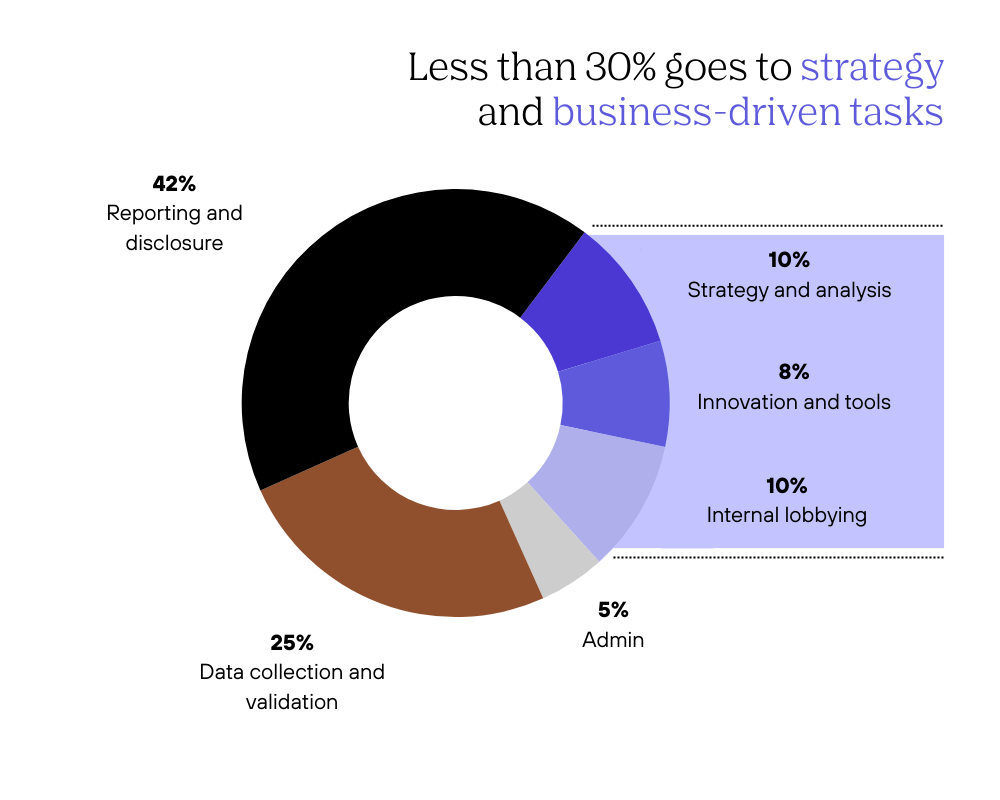
Less than 30% goes to strategy and business-driven tasks
These numbers explain why even high-profile teams struggle to influence core business decisions. The system they operate in simply doesn't leave them enough room.
In this environment, sustainability is too often perceived as a compliance cost, and budgets follow that perception. Unless the function can prove direct business value, it will lose weight in strategic planning. Cutting the administrative load and freeing capacity for high-impact work has become one of the most urgent challenges for sustainability leaders.
See it on your data
Get your team out of the reporting trap
See how beSirius shifts sustainability teams from 10% strategy to 60%+ by automating the repetitive work.
The four forces redefining sustainability performance in 2025
This imbalance is intensified by four external pressures that are reshaping corporate sustainability this year:
Regulatory volatility
New frameworks appear monthly (CSRD, CSDDD, CBAM), creating overlapping requirements across jurisdictions.
Disclosure overload
Overlapping frameworks and incompatible stakeholder requests.
Budget scrutiny
Resources only survive if tied to measurable business outcomes.
AI adoption
89% of enterprises are already using AI somewhere in the organisation (Deloitte 2025), raising the competitive bar for speed, accuracy, and insight.
The combined effect is a sustainability function under constant pressure: required to meet rising demands with fewer resources, shorter timelines, and less certainty about what will be enforced.
Free report
Get the full Sustainability Outlook 2025
All four forces, the data and the 2025 priorities in one report.
In this environment, teams that cannot show business impact and adapt their operating model will lose influence and budget to those that can.
Making time for what matters: AI in sustainability teams
Shifting from a reporting-heavy workload to strategic influence means redesigning how the function operates. Early adopters of technology-led operating models are reallocating their time toward activities that directly change business outcomes:
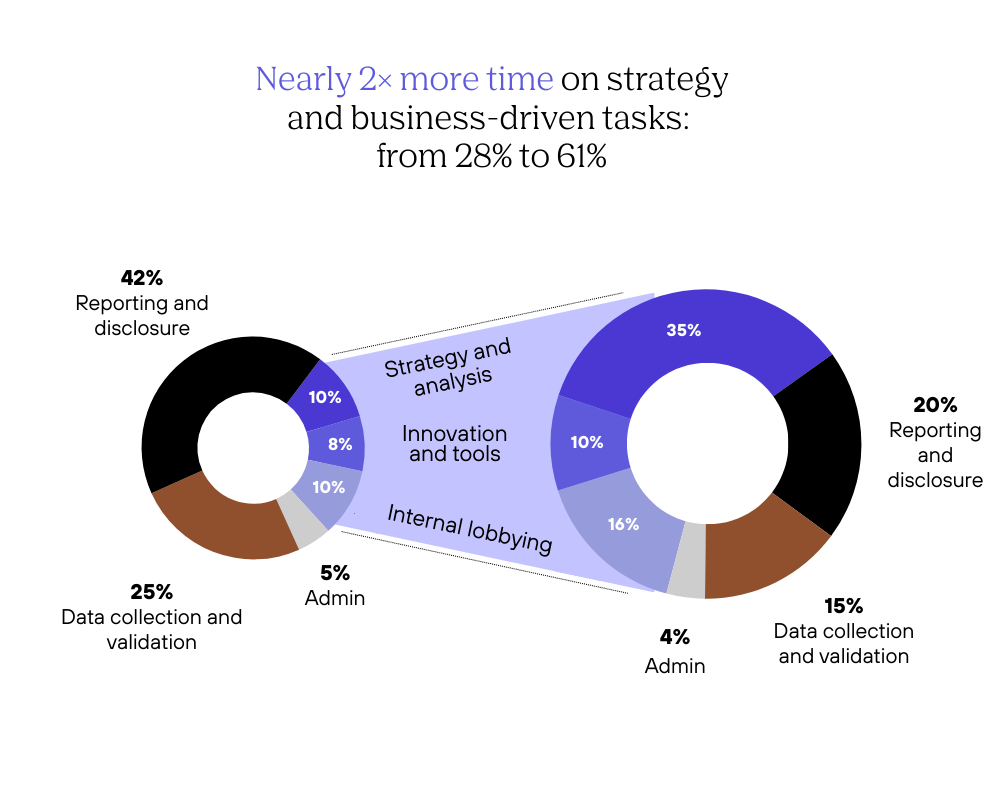
Nearly 2× more time on strategy and business-driven tasks: from 28% to 61%
This change is achieved by moving high-volume, rules-based processes to technology, and using AI to push the gains further. Operational results, aggregated from beSirius implementations across metals, mining, and industrial sectors:
60–80% less time spent on repetitive processes
€500K+ in annual savings for large multi-site operations and €150K–€250K for mid-size units
Stakeholder requests handled in hours instead of days, avoiding delays and protecting revenue
With this foundation, AI becomes the operating layer that links sustainability work directly to commercial decisions by surfacing insights, identifying risks, and enabling the function to match the speed of the business.
From cost center to growth engine: the new sustainability model
With this operational reset, sustainability is no longer just a compliance cost. It becomes a strategic capability tied to performance, risk, and resilience. The leaders are already using it to:
Win bids through verified sustainable products
Secure better financing through transparency
Build supply chain resilience with live intelligence
Connecting sustainability data directly to operational systems like procurement and finance turns ESG from an annual reporting exercise into a daily performance driver. See how a Sustainability knowledge base makes this operational.
Your 2025 sustainability roadmap for impact and ROI
The window for advantage is closing. Most enterprises already use AI somewhere, but sustainability teams that delay will fall behind on cost, speed, and influence.
They also have the clearest path forward. The repetitive, manual tasks that consume their time today are exactly what AI can automate best. Eliminating this busywork is essential for sustainability professionals to remain strategically relevant.
Sustainability Outlook 2025 - an analysis built from our work across metals, mining, and industrial sectors, combined with insights from sustainability professionals and leading market studies. It includes:
A clear picture of the operational and market shifts redefining sustainability's role
A breakdown of how leading teams are restructuring for measurable value
A practical roadmap for embedding AI into sustainability function, turning efficiency gains into strategic advantage and ROI
Ready when you are
From cost center to growth engine
Book a walkthrough and see how beSirius connects sustainability data to procurement, sales and finance decisions.