Newsletter - April 2026
 Anastasia Kuskova
THE ENERGY SHOCK
While one would prefer to avoid news altogether now, the Gulf conflict is hitting metals production from every direction at once, so we can’t skip it. Shipping through Hormuz has effectively stopped, so Gulf aluminium smelters can't get raw materials in or metal out. Aluminium Bahrain declared force majeure. Norsk Hydro's Qatar smelter cut to 60% after gas supply was disrupted. The Gulf accounts for roughly 8% of global aluminium output, and 500,000 to 600,000 tonnes of production have already been curtailed.
Then there is the chemical no one is talking about. The Middle East supplies roughly half of global seaborne sulphur, the raw material for sulphuric acid. Friedland calls it "the world's most important industrial chemical," and he is not wrong (is he ever). About 20% of the global copper supply depends on acid leaching. With Hormuz closed, that sulphur stopped shipping and acid prices passed $500 per tonne. Beijing saw the shortage coming and banned acid exports from May, redirecting its smelter byproduct to domestic fertilizer to protect its food supply. Chile buys over a million tonnes of Chinese acid per year and leaches a fifth of its copper with it. Now it has neither the raw material nor the finished product.
All of this is landing on a market that was already short. Copper crossed $13,000/tonne on the LME in Q1, and the IEA projects a 30% supply shortfall by 2035. EVs, AI data centres, power grids, and renewables all need copper, and none of these sectors is slowing down.
KEY UPDATES
As we all know, critical minerals are now at the top of the geopolitical agenda. The EU and US are starting to put real mechanisms in place that shape how materials are sourced, priced, and traded.
EU and US move closer on minerals
The EU and the US are working on a joint framework to reduce dependence on China for critical minerals. The focus is on coordinated investment, shared standards, and potential price support. Today, China controls 90% of rare earth processing, refines 45% of the world's copper, and since 2025 has been restricting exports of rare earths, gallium, germanium, antimony and sulphuric acid.
Key details, including price floors, subsidies and purchase guarantees, remain unresolved. In parallel, the EU launched RESourceEU on April 13 — a procurement platform designed to aggregate European demand and connect it with non-Chinese suppliers of rare earths, battery materials, and defence minerals. The Critical Raw Materials Act set a 65% single-country dependency cap in 2023. This is the first operational tool behind it.
The platform connects buyers and suppliers, but leaves them to finalize trades independently. Whether it leads to real supply depends on one thing: buyers showing up with actual purchase orders.
We’ll see.
Copper now classified as a US national security material
The US is approaching metals from the other end. Instead of coordinating procurement, it is using tariffs. The country produces only 3.3% of global refined copper but consumes more than almost anyone, importing 57% of what it uses. Copper was added to Section 232 in July 2025, classified as a national security material alongside steel and aluminium. In April, the White House restructured all three. Tariffs now apply to the full customs value of imported products, not just the metal content. Primary metal products pay 50%. Derivatives pay 25%. Products made entirely with US-origin metal pay 10%.
For copper, there is a new addition. Importers must now report the country where their copper was smelted and cast, a requirement that already existed for steel and aluminium. For anyone in the copper supply chain selling into the US, knowing and proving where your material was processed is no longer optional.
The Omnibus wraps up
Well, this is all you need to know.

KEY REPORTS
WEF x Kearney: From Minerals to Megawatts
This one is worth reading in full. Electric vehicles, AI data centres and electricity grids all need the same minerals. Copper, aluminium, rare earths, lithium, cobalt, graphite. EV demand exceeded 20 million vehicles in 2025. Data centre capacity is set to double by 2030, with each megawatt embedding 60 to 75 tonnes of minerals. The grid needs 60 million km of new or replacement lines by 2035. Same refining hubs, same bottlenecks, and none of these sectors are talking to each other about supply.
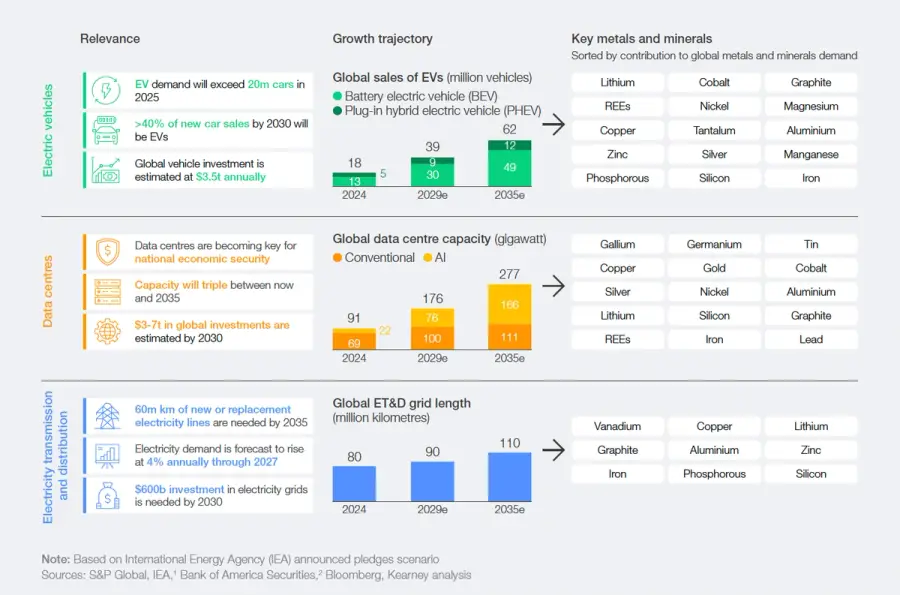
Overview of growth trajectory, and minerals and metals used for select value chains
Most companies still don't have visibility into where their mineral dependencies sit or where risks overlap across sectors. The report calls for better data infrastructure, common standards and coordination across the value chain. We obviously agree.
BCG: the AI-powered mining company
BCG's The AI-Powered Mining and Metals Company puts numbers on what we've been seeing on the ground. Companies that have deployed AI in mining report 2-5% throughput improvements, 2-4 percentage point margin gains and 20-30% reductions in unplanned downtime. Mining was near the bottom of BCG's AI adoption index. Now it sits in the middle. The gap between companies that have built AI into their workflows and those still evaluating it is getting wider every quarter.
REGULATORY UPDATES
EU Battery Regulation: passport countdown
From August 2026, batteries must carry labels with manufacturer info, capacity, hazardous substances and critical raw materials, with performance classes based on carbon footprint data. The digital battery passport follows in February 2027 for industrial batteries above 2 kWh and all EV batteries. To help the industry prepare, the GBA is running operational trials to test readiness across the value chain. Tesla, Panasonic and Rio Tinto are running their GBA assessments on the beSirius platform, where the Sustainability Twin automatically maps existing certifications to GBA criteria, links every result to source evidence, and reuses the same assessment across EUBR, OECD and buyer requirements. Contact us if you’d like to try this, too.
Switzerland proposes a due diligence law
Switzerland opened consultation on the Sustainable Corporate Management Act, running through July 9. Companies with 1,000+ employees and CHF 450M+ revenue get reporting obligations. Companies with 5,000+ employees and CHF 1.5B+ turnover get full due diligence requirements, including identifying and addressing human rights and environmental impacts across their operations. The thresholds are deliberately aligned with the EU Omnibus, and non-compliance can cost up to 3% of global turnover.
If you are ready to boost your due diligence approach with AI, we are running due diligence trials with a selected group of leading mining and metals companies. If you want to see how our platform could speed up your analysis, apply here.
In other regulatory news
- European Commission proposed ETS changes
- Von der Leyen announced a €30B “ETS investment booster” for industrial decarbonisation.
- Germany adopted an €8B Climate Protection Programme targeting 65% emissions cut by 2030.
If you want to stay on top of regulatory news every week, Green Digest is the one to read.
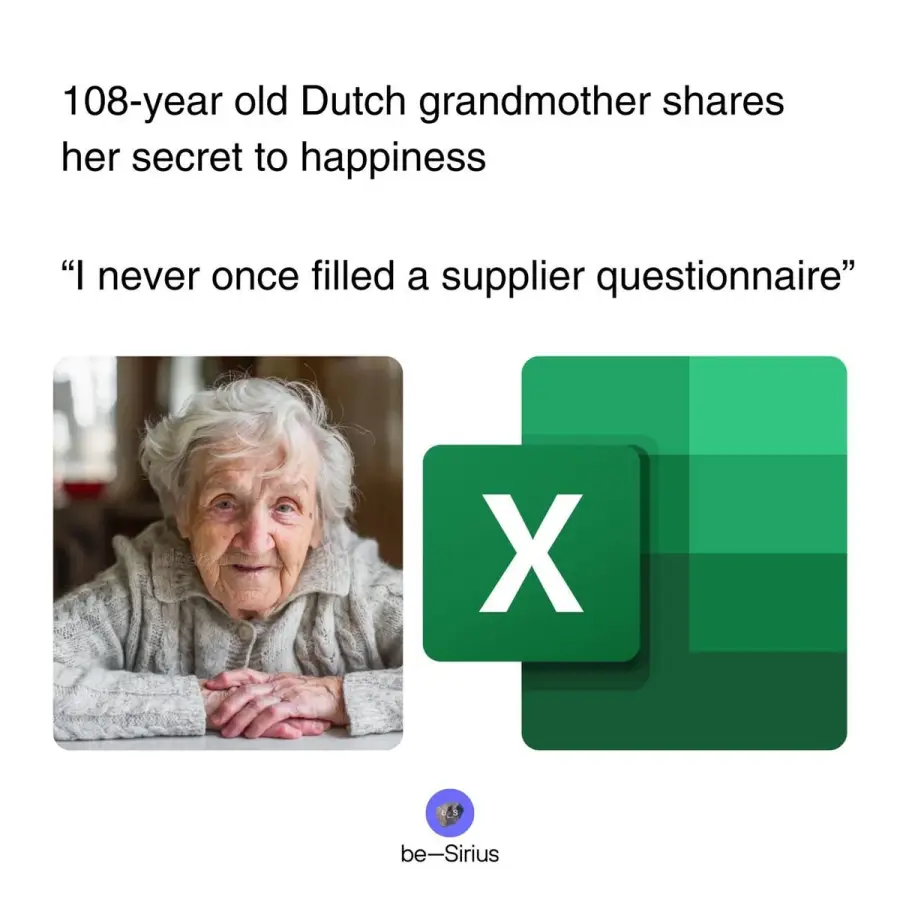
MEME OF THE MONTH
BESIRIUS UPDATES
Analyse your critical minerals suppliers
Sustainability and responsible sourcing teams at leading companies are using our platform to run critical mineral supplier due diligence, cutting assessment time from ~20 hours to 15–20 minutes, with audit-ready evidence behind every requirement.
We onboard new companies in small groups, so each team gets it running on their actual cases. The next group is open now.
Get ahead of CMSI before implementation hits
CMSI is being finalised for publication, and implementation is coming. We're already working with mining and metals companies to map their data against the consolidated standard, prepare assurance-ready evidence, and close compliance gaps before the pressure is on.
If you want to know exactly where you stand and have solid, board-ready proof ahead of the deadlines, apply for analysis now.
Events
Contact us for a meeting if you are around these events:
🇨🇭FT Commodity Summit (April 21-22)
🇨🇭Hack Summit (April 22-23)
🇪🇸 Cobalt Congress 2026 (May 12–13)
🇧🇪 EIT Raw Materials (May 19–22)
🇬🇧 LBMA/WGC Sustainability & Responsible Sourcing Summit 2026 (June 17–19)