
Quick answer
The Conflict Minerals Reporting Template (CMRT) is used to collect information about minerals, suppliers, smelters and refiners in a supply chain. A reliable process starts with the reporting scope, gathers supplier responses, checks the data against the relevant RMI guidance, and records what is supported, partial or missing.
Who this is for: Compliance, procurement and sustainability teams in mining, metals, electronics and manufacturing who have to submit or collect a CMRT.
Not what you're looking for? If you were searching for the CMRT maintenance and reliability technician certification, that's a different subject — this page is only about conflict minerals reporting.
How to complete a CMRT
Recommended workflow
- Confirm the reporting period, products and in-scope minerals.
- Send the correct current RMI template to suppliers.
- Validate supplier, smelter and refiner information.
- Record evidence and unresolved gaps instead of silently filling them.
- Review the completed file before submission or customer response.
Get the current template and instructions from the official RMI CMRT page. The current template is CMRT 6.6; see what changed in CMRT 6.6. To check which version to send, see CMRT, EMRT and AMRT versions; to pick the right template, see CMRT vs EMRT vs AMRT; to run the workflow across suppliers, see RMI automation.
Staying compliant with conflict minerals reporting requirements is becoming more complex every year. For many organisations in the metals, mining and industrial sectors, completing the CMRT means coordinating suppliers across continents, keeping pace with changing smelter information and reconciling multiple data sources under tight timelines. Responsible sourcing is no longer a "nice to have", it is a core part of doing business.
What do you need before you start?
The Conflict Minerals Reporting Template (CMRT) is the industry's standard questionnaire developed by the Responsible Minerals Initiative (RMI) for tracing the sourcing of tin, tantalum, tungsten, and gold (3TG). These minerals often originate from conflict-afflicted and high-risk areas (CAHRAs) such as the Democratic Republic of Congo (DRC) and nearby countries, where the mineral trade has historically been linked to armed conflict and human rights abuses.
The purpose of the CMRT is simple: improve supply-chain transparency and reduce the risk of accidentally sourcing conflict-linked minerals. But translating that purpose into reliable reporting is where many companies struggle. CMRT data depends heavily on supplier inputs, smelter verification and version control. And when any part of that chain breaks down, gaps appear quickly. Those gaps can have real consequences for compliance, audits and customer relationships.

3TG: Tin, Tantalum, Tungsten and Gold
See it on your data
See CMRT automation in practice
A short walkthrough on your own supplier data.
Incomplete or inaccurate CMRT reporting can expose companies to:
Regulatory questions
Customer concerns
Reputational and investor pressure
Contract delays or loss
Deeper audits and compliance reviews
And these risks are not abstract, they happen in real life. For example:
When traceability systems break down, and when minerals tagged as "conflict-free" are later found to have been mixed with material from high-risk or unverified sources.
When a supplier reports unknown smelters and a customer flags the company for insufficient due diligence.
When journalists or NGOs publish reports showing a manufacturer used 3TG from a high-risk smelter not on an approved list.
When a major buyer asks for a clean CMRT for contract renewal and discovers gaps or inconsistencies in the company's data.
When investors see a company listed in an NGO report for weak supply chain controls, leading to public statements or internal reviews.
In many cases, all of this traces back to the same issue: a CMRT submission that was incomplete, inconsistent or not backed by verified supplier data. This is why accurate CMRT reporting matters. Strong data protects the business, builds trust with customers and suppliers, reassures investors and compliance teams, and shows that responsible sourcing practices can withstand real scrutiny.
What is the Conflict Minerals Reporting Template?
Over the past decade, the CMRT has evolved from a simple spreadsheet into a globally recognized due diligence standard. Early releases focused on formatting fixes and building out the smelter list. Later versions aligned with IPC-1755, the EU Conflict Minerals Regulation, and expanded due diligence requirements. The 6.x series introduced clearer instructions, stronger validation logic, and continually updated RMI smelter reference data. Always verify the current template and instructions on the official RMI site before sending a questionnaire.
Our CMRT, EMRT and AMRT versions tracks what changed in each release, and CMRT vs EMRT vs AMRT explains which template to use for minerals beyond 3TG. The CMRT is structured into several tabs, including:
Declaration
Core due diligence questions
Smelter List
Required smelter and refiner disclosures
Checker
Validation logic for data completeness
Instructions
Guidance for suppliers and reporting companies
Companies are expected to use the most recent version for each reporting cycle to avoid inconsistencies with smelter IDs, outdated lists or incompatible declarations.
How do you complete a CMRT, step by step?
1. Identify all relevant suppliers
Prepare a complete list of suppliers that use or may supply tin, tantalum, tungsten or gold (3TG), including tier-one and high-risk upstream suppliers.
2. Distribute the current CMRT version
Send the current RMI template to all suppliers. Ask them to complete sourcing information, smelter details and due diligence fields.
3. Collect supplier declarations
Gather all completed CMRT files. Expect mixed formats, versions and varying data quality across responses.
4. Validate smelters and refiners
Check each smelter ID and name against the RMI Standard Smelter List and Smelter Reference List. Flag unknown, invalid or outdated entries.
5. Review due diligence answers
Ensure supplier responses align with your company policies, sourcing practices and risk-assessment procedures.
6. Resolve inconsistencies and missing data
Follow up with suppliers to correct incomplete fields, conflicting answers, outdated template versions or unverifiable smelters.
7. Consolidate all supplier CMRTs
Merge smelter lists, declarations and due diligence information into a single master CMRT file. Ensure all required tabs (Declaration, Smelter List, Checker) are complete.
8. Perform a final accuracy check
Run the Checker tab, validate data consistency, confirm smelters and ensure no required fields are missing.
9. Submit the final CMRT
Provide the completed CMRT to customers, auditors or internal compliance teams. Retain documentation for audits and responsible-sourcing reviews.
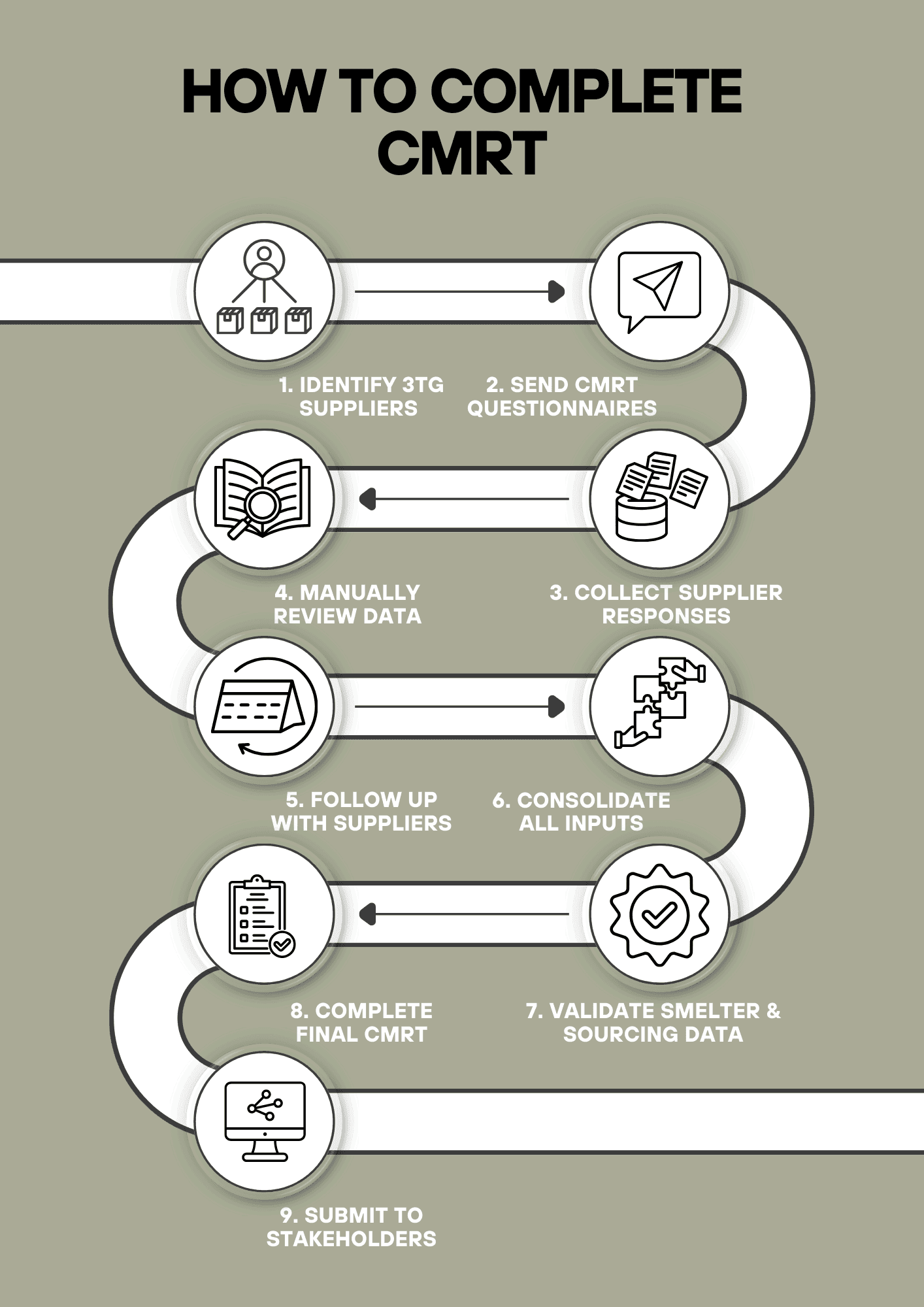
Traditional workflow: how to prepare your CMRT form
Why is CMRT reporting so hard?
CMRT compliance appears simple on the surface, but behind each submission is a chain of moving parts that rarely behave as planned. Most of the complexity comes from suppliers, data consistency, and constant updates to RMI reference information. The most common issues include:
Late supplier responses
Outdated or incomplete declarations
Smelters that cannot be verified
Conflicting or inconsistent data
Mixed CMRT versions submitted across the supply base
RMI smelter lists that update throughout the year
As reporting season approaches, these problems tend to multiply, and teams spend weeks chasing corrections, clarifications and updated forms. Across the industry, several deeper pain points consistently appear:
Supplier data quality and version control
Smelter verification against evolving RMI lists
Regulatory shifts in responsible-sourcing expectations
Pressure from customers, auditors and investors for faster answers
High data volumes — sometimes hundreds or thousands of CMRTs
The result is a time-sensitive reporting rush with very little margin for error.
End the CMRT scramble
Stop chasing suppliers every reporting cycle
See how beSirius automates supplier outreach, smelter validation and CMRT consolidation end to end.
How does automation change CMRT reporting?
beSirius automates the process by collecting data from different documents and sources, combining it into the current RMI CMRT template, resolving alignment issues and managing everything in one workflow. Teams receive validated, auditable data without repetitive manual consolidation.
How it works: step-by-step workflow
1. Enter basic reporting inputs
Select CMRT, choose scope, set minerals and (optionally) add suppliers/refiners.
2. Auto-populate CMRT fields
beSirius fills declaration tabs, company details, policies and due diligence fields from the Twin.
3. Pull products and suppliers automatically
The platform identifies relevant products and suppliers using BOMs, sourcing data and supplier hierarchies.
4. Upload and consolidate supplier CMRTs
beSirius validates template versions, normalises fields and merges all supplier responses into one clean dataset.
5. Validate smelters and facilities
Entries are checked against the latest RMI lists; unknown or duplicate smelters are flagged automatically.
6. Generate consistent due diligence answers
Policies, CAHRA methodology and risk assessments are reused and adapted to the CMRT question wording.
7. Collaborate in one place
Assign tasks, track supplier progress, store documents, and capture comments without spreadsheets or emails.
8. Review and export final CMRT
The fully populated, validated template is ready for review and submission.
Key advantages
Automatic population of CMRT fields using the Twin
Error-proof consolidation of supplier CMRTs, regardless of version or format
Smelter validation against the latest RMI reference lists
One unified workflow with no spreadsheet versioning or manual handovers
Real-time collaboration across procurement, ESG, legal and compliance teams and suppliers
Full traceability from suppliers to smelters to due diligence records
Reusable data, making each CMRT cycle significantly faster and more reliable
Because everything lives within the Twin, updates to suppliers, smelters or internal policies flow automatically into all future CMRT cycles, turning reporting into a predictable, accurate and far less manual process.
See it on your data
One audited CMRT from every supplier response
Watch beSirius consolidate mixed CMRT versions, validate smelters against the latest RMI lists and produce a submission-ready file.
How does CMRT fit into wider due diligence?
CMRT is one recurring requirement within a broader responsible sourcing and supplier due diligence process. The same supplier records, policies, smelter data, risk assessments and supporting documents used for CMRT are often relevant to other reporting and assessment requirements.
beSirius keeps this evidence in a structured record so it can be reused across CMRT, EMRT, AMRT and other assessments. Instead of collecting the same information again for every request, teams can check existing evidence against the relevant requirements and see what is supported, what is missing and what still needs follow-up.
CMRT best practices
To make your CMRT reporting more efficient and easier, consider these best practices:
Centralize evidence and supplier data
Keep supplier declarations, smelter information, policies, previous assessments and supporting documents in one structured record so the same evidence can be reused across reporting cycles and related due diligence requests.
Automate data collection
Leverage AI to automate the collection and validation of supplier data.
Regularly update policies
Stay informed about regulatory updates and incorporate them into your reporting process.
Conduct supplier risk assessments
Identify and mitigate potential risks in your supply chain.
Use standardized templates
Use the current RMI template to ensure consistency.
Ready when you are
Turn CMRT reporting from a scramble into a routine
Book a 30-minute walkthrough and see beSirius run on your own supplier base.
Where can you download the current CMRT template?
The Conflict Minerals Reporting Template is published by the Responsible Minerals Initiative on the official RMI CMRT page. Always start a new reporting cycle from the current RMI template — older files carry outdated smelter reference lists, which is the single most common cause of failed validation.
If you want the CMRT template download alongside the EMRT and AMRT files, plus a walkthrough of every tab, see our RMI Templates Guide. To send, collect and validate those templates across your supplier base automatically, see RMI automation.
Frequently Asked Questions
What is CMRT?
The Conflict Minerals Reporting Template (CMRT) is a standardized reporting tool created by the Responsible Minerals Initiative (RMI) to help companies disclose the use and origin of tin, tantalum, tungsten and gold (3TG) in their supply chains.
Why is CMRT required?
The CMRT supports conflict minerals due diligence requirements by increasing supply-chain transparency and helping companies identify whether their 3TG sourcing may be linked to armed conflict or human rights risks.
Which minerals are covered by CMRT?
The CMRT covers four minerals known as "3TG": tin, tantalum, tungsten and gold. These materials may originate from high-risk regions such as the Democratic Republic of Congo (DRC) and adjoining countries.
What is the latest CMRT version?
CMRT 6.6, released by RMI on 17 April 2026, together with EMRT 2.11 and AMRT 1.31. Always download the current template and instructions from the official RMI site before sending a questionnaire.
How often should companies update their CMRT?
Most companies update their CMRT annually, though updates may be needed sooner if supplier sourcing changes, smelter data shifts or new risk information emerges.
What information does CMRT collect?
The CMRT gathers details on supplier 3TG sourcing, smelters and refiners used, country-of-origin information, supply-chain due diligence practices, and policies, controls and risk-assessment procedures.
Why is CMRT reporting often challenging?
Common difficulties include inconsistent supplier declarations, mixed CMRT versions, missing or outdated smelter data, and manual cross-checking against RMI reference lists. Large companies may need to consolidate hundreds or thousands of supplier responses.
How is smelter information validated?
Companies verify smelter names and IDs against the RMI's Standard Smelter List and Smelter Reference List. These lists are updated regularly, which can create alignment issues when suppliers use older template versions.
How can companies improve CMRT accuracy and efficiency?
By using centralized data, maintaining consistent documentation, aligning template versions, engaging suppliers early, and validating smelters against the latest RMI lists. Automation tools can significantly reduce manual consolidation and errors.
How does beSirius support CMRT reporting?
beSirius automates CMRT population, validates supplier and smelter data against the latest RMI lists and consolidates all inputs into one clean template, reducing manual work and improving accuracy.
How do you automate CMRT reporting?
Automation replaces the three manual steps that take the most time: sending and chasing the template, reading what comes back, and checking smelters. In practice that means one outreach round from a single supplier list, declarations parsed automatically no matter which CMRT version a supplier used, every smelter ID matched against the current RMI Standard Smelter List, and a consolidated master template generated from the validated data. What is left for the team is judgement on the flagged rows, not re-keying.
How long does it take to complete a CMRT?
Filling your own template from data you already hold takes a few hours. The time goes into the supplier round: collecting, chasing and validating declarations across a supply base typically runs six to ten weeks manually, and the bulk of it is follow-up on incomplete or outdated files rather than reporting work.
Is the CMRT template free to download?
Yes. The Responsible Minerals Initiative publishes the CMRT free of charge on its website. RMI membership is not required to download or use it.
Who has to complete a CMRT?
Anyone asked for one by a customer. There is no rule that names companies directly. The obligation travels down the supply chain from filers under the US Dodd-Frank Act and importers under the EU Conflict Minerals Regulation, which is why a supplier several tiers from the regulation still receives the request.