
Update: This article covers CMRT 6.5, released in April 2025. RMI released CMRT 6.6 on 17 April 2026. For the current template and the latest changes, see our CMRT 6.6 update.
Quick answer
CMRT, EMRT and AMRT serve different reporting scopes. The correct choice depends on the minerals, risks and information requested in your due-diligence process. Always verify the current template and instructions on the official RMI site before sending a questionnaire.
Who this is for: Teams that already collect CMRTs and need to know which version to send, and what changed since 6.01.
Not what you're looking for? This is the Conflict Minerals Reporting Template (3TG), not the maintenance and reliability technician certification.
Which RMI template should you use?
Keep historical versions clearly labelled as historical. Never describe an older version as the current template.
Check the current files on the official RMI reporting templates page. For the reporting workflow, see how to complete a CMRT; to compare scopes, see CMRT vs EMRT vs AMRT.
The Conflict Minerals Reporting Template (CMRT) is the most widely used reporting tool for 3TG due diligence across global supply chains. As regulatory expectations and industry practices evolve, the CMRT continues to be updated to ensure accuracy, consistency, and alignment with recognised standards. Understanding how CMRT versions have evolved, particularly within the CMRT 6.x series, helps organisations manage compliance, reduce reporting friction, and maintain confidence in their conflict minerals data.
What changed in each CMRT version?
The Responsible Minerals Initiative (RMI) provides several standardised reporting templates to support responsible sourcing and supply chain due diligence. Among these, the Conflict Minerals Reporting Template (CMRT) is the most widely adopted. The CMRT enables companies to collect, standardise, and share information on tin, tantalum, tungsten, and gold (3TG) across global supply chains. As regulatory expectations, industry standards, and due diligence practices evolve, the CMRT template has evolved alongside them through both major structural updates and frequent minor revisions. Understanding the CMRT version history is essential for organisations managing conflict minerals reporting, supplier disclosures, and regulatory compliance.
How do RMI templates relate to the CMRT?
The CMRT sits alongside two sibling templates — see CMRT vs EMRT vs AMRT for which one covers which minerals, and our step-by-step CMRT completion guide for the reporting workflow itself.
RMI templates are designed to create consistency and comparability across complex, multi-tier supply chains. Within this ecosystem, the CMRT has become the default reporting tool for conflict minerals due diligence. Since its first release in 2011, the Conflict Minerals Reporting Template has been updated to reflect changes in global regulations, updates to smelter and refiner reference data, alignment with IPC-1755 standards, and feedback from suppliers, manufacturers, and downstream companies. As a result, the CMRT version history includes both foundational changes and long periods of refinement.
CMRT version history overview
Before focusing on the CMRT 6.x series, it helps to understand how the CMRT has evolved over time.
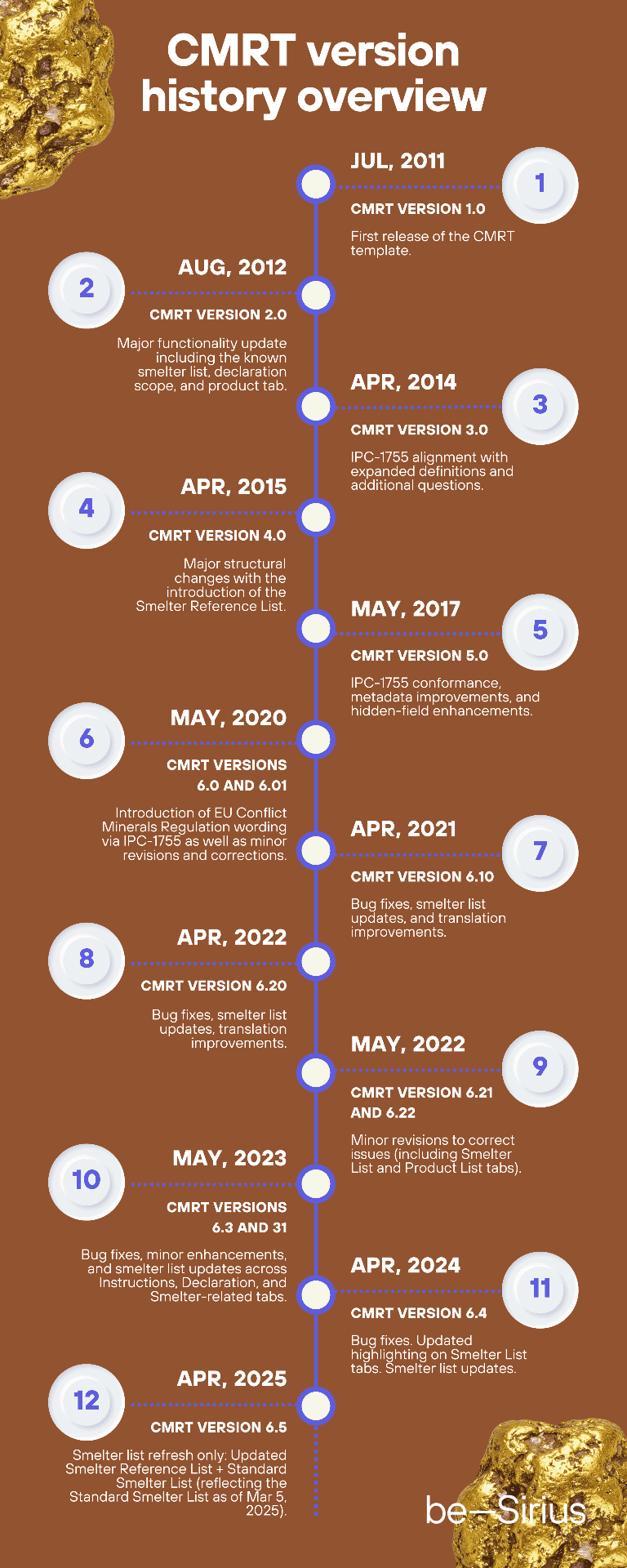
CMRT version history overview (author: beSirius)
See it on your supplier base
Run CMRT, EMRT and AMRT in one workspace
Collect, validate and roll up CMRT responses on the current RMI template without chasing suppliers.
CMRT 6.01: the start of the CMRT 6.x series
The release of CMRT version 6.01 marked the formal beginning of the CMRT 6.x series. While CMRT version 6.0 introduced EU Conflict Minerals Regulation wording through IPC-1755 alignment, CMRT 6.01 focused on correcting issues identified shortly after release. These updates addressed practical reporting issues without introducing new reporting requirements.
Key updates in CMRT 6.01 included fixes related to the Product List tab, clarifications in declaration scope, and overall stabilisation of the CMRT 6.x framework.
CMRT 6.10 and CMRT 6.2x: maintenance and consistency
CMRT version 6.10 introduced bug fixes, smelter list updates, and translation improvements. The focus was improving reliability and consistency rather than changing reporting workflows.
CMRT versions 6.20, 6.21, and 6.22 continued this maintenance-driven approach, introducing minor revisions to address reported issues, corrections to the Smelter List and Product List tabs, and ongoing alignment with current RMI reference data. These CMRT versions helped ensure consistency across suppliers and jurisdictions.
CMRT 6.3 and CMRT 6.31: improving data accuracy
CMRT version 6.3 delivered bug fixes, updated guidance in the Instructions tabs, minor usability enhancements, and smelter list updates.
CMRT version 6.31 followed shortly after, addressing issues related to the Declaration, Smelter List, and Smelter Look-up tabs. Together, these CMRT versions reduced inconsistencies in supplier submissions and improved the reliability of reported CMRT data.
CMRT 6.4 and CMRT 6.5: keeping reference data current (historical)
CMRT version 6.4 introduced bug fixes, updated highlighting in Smelter List tabs, and a refresh of smelter reference data.
Released in April 2025, CMRT version 6.5 is a historical version. It focused exclusively on refreshing the Smelter Reference List and Standard Smelter List, aligning them with the Standard Smelter List as of 5 March 2025.
CMRT 6.5 did not introduce new questions or workflow changes. Its purpose was to ensure that CMRT reporting remains accurate by keeping reference data current.
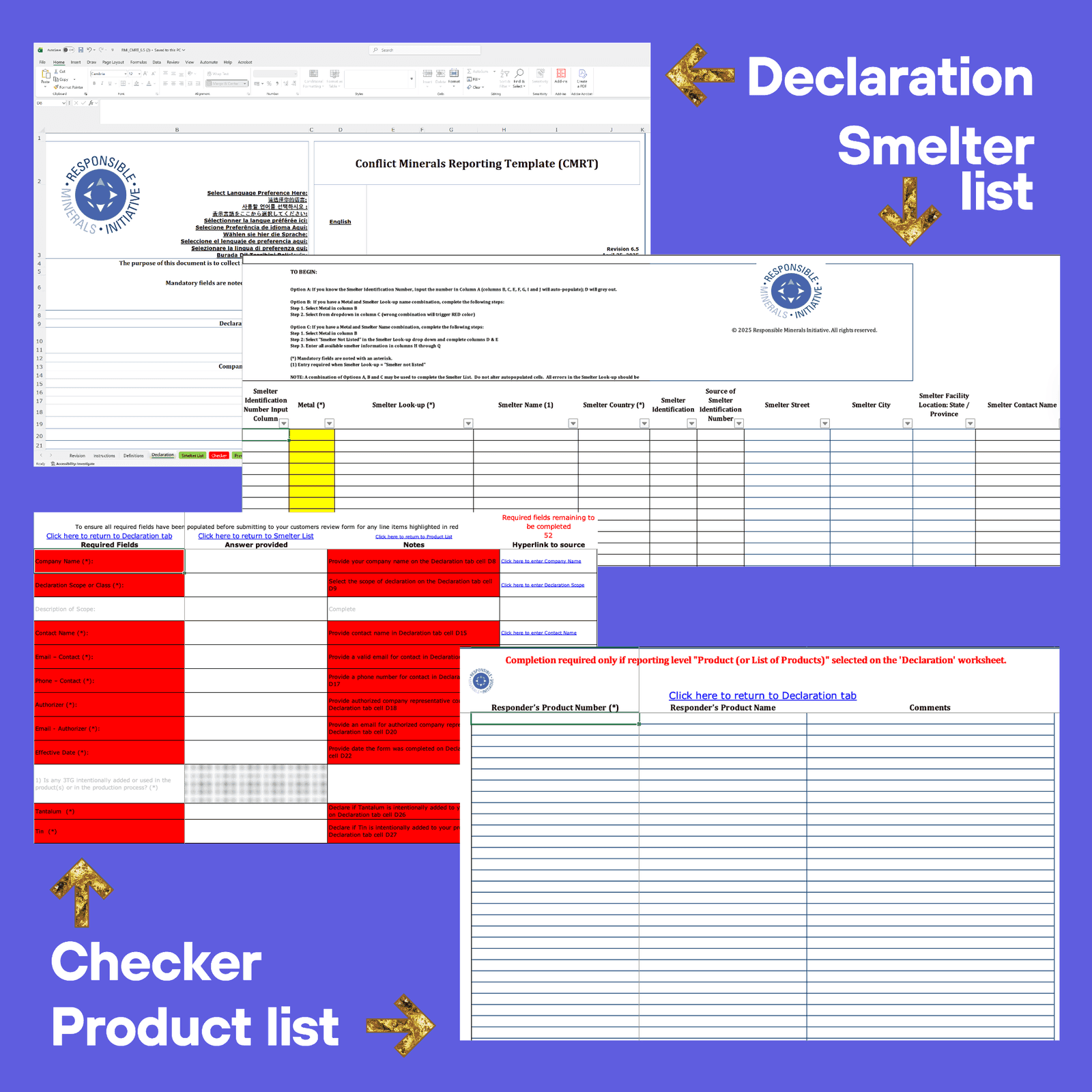
CMRT version 6.5: Declaration, Smelter list, Checker, Product list (author: beSirius)
Which CMRT version should you send suppliers?
The CMRT 6.x version history reflects a clear shift in how the Conflict Minerals Reporting Template is maintained and used across global supply chains. Rather than introducing frequent structural changes, the CMRT 6.x series prioritises stability, data accuracy, and alignment with recognised industry standards.
For organisations using the CMRT, this has several practical implications.
Stronger compliance alignment
Each CMRT version update in the 6.x series supports continued alignment with global due diligence expectations, including IPC-1755 and EU Conflict Minerals Regulation language introduced in earlier CMRT versions. Using the current RMI template helps organisations demonstrate up-to-date compliance while reducing regulatory and reputational risk. Updates, particularly to smelter reference and standard smelter lists, ensure that CMRT reporting reflects current RMI data and commonly accepted industry references.
More reliable CMRT data
Across the CMRT 6.x versions, repeated bug fixes, validation improvements, and smelter list updates have improved data integrity. These refinements reduce inconsistencies in supplier CMRT submissions and help organisations rely on more accurate, comparable conflict minerals data across their supply base. In practice, this means fewer reporting errors, clearer declarations, and improved confidence in CMRT disclosures.
Lower operational friction
Recent CMRT versions, including CMRT 6.4 and CMRT 6.5, are designed as incremental improvements rather than major workflow changes. The operational benefit is straightforward: fewer issues caused by outdated reference data, less rework, and reduced back-and-forth with suppliers over incorrect or invalid CMRT entries. For many organisations, the biggest gain from a current CMRT version is not new functionality, but smoother execution.
Continued alignment with industry practice
The CMRT remains the most widely adopted conflict minerals reporting template provided by the Responsible Minerals Initiative. The CMRT 6.x series reinforces its role as a standardised tool for 3TG reporting, supporting consistent disclosures across industries and supply chains. By staying aligned with the current RMI template, organisations position themselves in line with common due diligence expectations and peer practices.
How do you check the current CMRT version, and where is the smelter list?
Always verify the current template and instructions on the official RMI CMRT page before sending a questionnaire. Each release carries reference data: the Standard Smelter List and Smelter Reference List embedded in the template's smelter list tab.
Those lists are why version matters in practice. A supplier filing on CMRT 6.31 or older will reference smelter IDs that no longer match the current RMI smelter list, and the Checker tab flags them as invalid even when the sourcing itself is fine. Before each cycle, confirm the current version on the RMI site — or let RMI automation validate every declaration against the current lists for you.
Final takeaway
The CMRT 6.x version history shows a mature reporting framework focused on accuracy, consistency, and regulatory alignment. The release of CMRT 6.5 continued this approach, keeping smelter reference data current without introducing unnecessary complexity. For organisations engaged in conflict minerals reporting, keeping pace with CMRT version updates is less about adapting to change and more about avoiding risk, reducing friction, and maintaining confidence in CMRT data over time.
To automate CMRT, EMRT and AMRT in one workspace, see our RMI automation solution or the in-depth RMI Templates Guide.
See it live
See CMRT reporting running on a live supplier base
Walk through the RMI automation workspace with our team using your own data.
Frequently asked questions
What is the latest CMRT version?
CMRT 6.6, released by RMI on 17 April 2026, is the current version. CMRT 6.5, covered in this article, was released in April 2025 and is now a historical version. Always verify the current template and instructions on the official RMI site before sending a questionnaire.
What is the difference between CMRT 6.5 and 6.4?
Only the reference data. CMRT 6.5 refreshes the Standard Smelter List and Smelter Reference List to match the RMI list as of 5 March 2025. The questions, tabs and validation logic are identical to CMRT 6.4, so no re-work is needed on declarations already collected on 6.4.
Where do you download the latest CMRT template?
From the Responsible Minerals Initiative website, free of charge. Start each cycle from a freshly downloaded file rather than a saved copy, because an older file carries an outdated smelter list and the Checker tab will flag valid smelters as invalid.
Can suppliers still submit an older CMRT version?
They can, and many do. The declarations remain readable, but smelter IDs referenced from CMRT 6.31 or earlier may no longer match the current RMI list, which shows up as validation errors that are data-age issues rather than sourcing problems. Either ask for a resubmission on the current RMI template or map the old IDs to current ones before consolidating.
How often is the CMRT updated?
Roughly once or twice a year. Most releases in the 6.x series are maintenance updates covering bug fixes, translations and refreshed smelter reference data, not new questions. Structural change is rare and announced well in advance by RMI.
Does the CMRT version affect compliance?
Indirectly. No regulation names a version, but using the current one avoids invalid smelter references and shows customers and auditors that your data reflects the latest RMI reference lists. In practice, mixed versions across a supply base cost more time than any single filing decision.