
Quick answer
CMRT, EMRT and AMRT are not interchangeable labels. Use the template that matches the minerals and reporting scope in your programme, then confirm the current official version before distribution.
Who this is for: Compliance and procurement teams deciding which RMI template to send suppliers — and how to consolidate the responses.
Not what you're looking for? These are the Responsible Minerals Initiative reporting templates, not technician or maintenance certifications.
CMRT vs EMRT vs AMRT in one minute
| Template | Use it when | Check before sending |
|---|---|---|
| CMRT | Your programme covers conflict minerals reporting. | Scope, supplier population and current RMI file. |
| EMRT | Your programme covers extended minerals reporting. | Applicable minerals, questions and guidance. |
| AMRT | Your programme requires the relevant expanded reporting scope. | Official RMI instructions and reporting period. |
Confirm current template names, files and release information on the official RMI pages for the CMRT, EMRT and AMRT. See also how to complete a CMRT, CMRT, EMRT and AMRT versions, and the beSirius supplier due-diligence workflow.
Minerals reporting can be complex, but choosing the right template doesn't have to be. The CMRT, EMRT, and AMRT each cover different mineral groups and compliance needs. Understanding their scopes helps you streamline reporting, meet regulatory expectations, and improve supply chain transparency.
Looking to automate CMRT/EMRT/AMRT workflows? Explore RMI Automation Module for smarter due diligence and real-time reporting.
What is the CMRT?
The Conflict Minerals Reporting Template (CMRT) is the standard questionnaire used to disclose the sourcing of tin, tantalum, tungsten and gold (3TG). These minerals often originate from conflict-affected or high-risk areas such as the DRC and adjoining countries, which is why regulators and customers require visibility into their supply chains. The CMRT supports compliance with the Dodd-Frank Act Section 1502 and is updated annually by the Responsible Minerals Initiative, typically including revised smelter lists and guidance. For many companies, the CMRT is the starting point for mineral due diligence. See our step-by-step CMRT completion guide and the CMRT, EMRT and AMRT versions.
Best for: companies reporting 3TG or responding to customer requests for conflict minerals compliance.
What is the EMRT?
The Extended Minerals Reporting Template (EMRT) is used to gather due diligence information on minerals beyond 3TG. It was initially focused on cobalt and natural mica, but newer versions now cover additional minerals such as copper, natural graphite, lithium and nickel, reflecting changes in global supply chains and regulatory expectations. The EMRT helps companies collect structured supplier data, assess risks and maintain transparency as reporting obligations expand.
Its broader scope makes it particularly relevant for industries where new critical minerals play a central role, such as batteries, electronics and energy transition materials.
Best for: organisations needing wider minerals due diligence across modern, multi-mineral supply chains.
What is the AMRT?
The Additional Minerals Reporting Template (AMRT) is designed for minerals that fall outside the scope of the CMRT and EMRT. It offers a flexible structure for reporting on emerging, niche or newly regulated minerals, making it useful for organisations operating across wide or evolving mineral portfolios.
As supply-chain expectations broaden, the AMRT helps companies collect consistent data, address transparency requirements and prepare for future regulatory attention.
Its adaptable format is particularly valuable for businesses managing diverse minerals or anticipating shifts in due-diligence expectations.
Best for: companies with varied mineral portfolios or preparing for upcoming reporting requirements.
Key differences: CMRT vs EMRT vs AMRT
The CMRT, EMRT and AMRT differ in scope, mineral coverage and how each template defines what must be reported. These differences relate to which minerals are included, whether the list is fixed or extended, and how flexible the template is for adding additional materials.
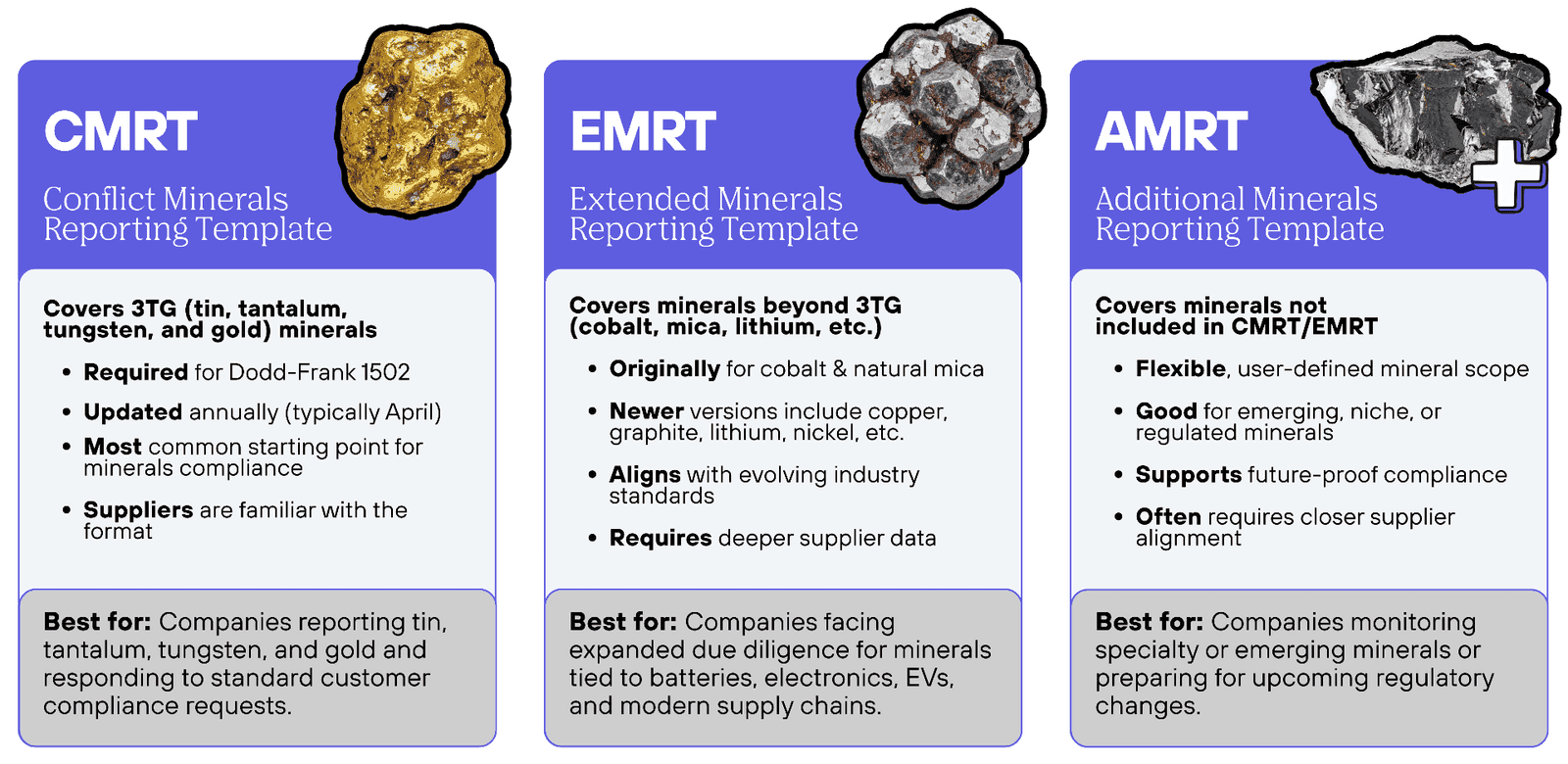
CMRT, EMRT, AMRT - key differences (author: beSirius)
One workspace, three templates
Consolidate CMRT, EMRT and AMRT in one supplier workspace
Stop running three parallel processes — see how beSirius handles all RMI templates together.
How do you choose the right minerals reporting template?
Choosing the right template starts with understanding which minerals are in scope for your organisation and matching them to the template designed to cover them. Regulatory requirements also play a role, since different regions and customers may expect specific formats. Supply-chain complexity and the level of detail needed for due diligence should also guide the decision. Finally, assess whether your internal reporting resources can support the data collection and verification each template requires.
Key steps:
Identify minerals in scope
Review regulatory and customer requirements
Assess supply-chain complexity
Evaluate reporting capacity
How do you keep declarations audit-ready?
Effective minerals reporting relies on clear processes, reliable supplier information and ongoing awareness of regulatory changes. Establishing consistent data-collection procedures and working closely with suppliers improves accuracy and reduces follow-up work. Regular training also helps teams stay aligned with evolving expectations.
Key practices:
Standardise reporting procedures
Strengthen supplier engagement
Maintain ongoing compliance training
Applying these practices supports smoother reporting cycles, reduces compliance risk and creates a more transparent supply chain that stands up to customer, regulatory and investor expectations.
What comes after reporting?
Selecting the right reporting template is a key step in managing minerals responsibly. Aligning the CMRT, EMRT and AMRT with the needs of your supply chain helps ensure the information you collect is accurate and fit for purpose.
Applying solid reporting practices strengthens compliance and supports responsible sourcing efforts. These actions build transparency, reduce risk and reinforce trust with customers, regulators and stakeholders.
Responsible sourcing, at scale
See RMI reporting run live across your supplier base
Walk through the RMI automation solution with our team using your own suppliers.
How do you check the current CMRT, EMRT and AMRT versions?
CMRT is the most frequently revised of the three, so confirm the current official version before distribution. The current versions are CMRT 6.6, EMRT 2.11 and AMRT 1.31; see what changed in the 2026 RMI template releases. The Extended Minerals Reporting Template (EMRT) is updated as new minerals enter scope, so check the EMRT latest version before each cycle rather than reusing last year's file. The Additional Minerals Reporting Template (AMRT) changes least often, because its mineral fields are meant to be filled in per request.
Version drift is the practical risk: mixed template versions across suppliers mean mismatched smelter IDs and failed validation. Download the current CMRT, EMRT and AMRT template files together in the RMI Templates Guide, or have RMI automation keep every supplier on the right version automatically.
Frequently Asked Questions
What is the CMRT?
The Conflict Minerals Reporting Template (CMRT) is a standardized questionnaire from the Responsible Minerals Initiative (RMI) used to disclose the sourcing of tin, tantalum, tungsten and gold (3TG) across a supply chain, including smelters, refiners and country of origin.
What does AMRT stand for?
AMRT stands for the Additional Minerals Reporting Template. It is a flexible RMI template used to collect due diligence data on minerals that are not covered by CMRT (3TG) or EMRT (cobalt, mica and other extended minerals) — typically emerging or niche materials relevant to a specific supply chain.
What is the difference between CMRT, EMRT and AMRT?
CMRT covers 3TG (tin, tantalum, tungsten, gold). EMRT covers extended minerals such as cobalt, natural mica, copper, graphite, lithium and nickel. AMRT is used for any other mineral outside CMRT and EMRT scope. All three follow the same RMI due diligence structure so responses can be consolidated.
Do I need all three templates?
Only use the templates that match the minerals in your products. Companies with 3TG exposure need CMRT; those handling cobalt, mica or similar extended minerals need EMRT; AMRT is added when reporting on minerals outside those scopes. Many mining, metals and manufacturing companies end up filing at least two.
Is EMRT replacing CMRT?
No, CMRT remains the required template for 3TG conflict minerals due diligence and is still the industry standard. EMRT extends coverage to additional minerals but does not replace CMRT — the two templates run in parallel.
What minerals are covered by EMRT?
EMRT covers cobalt and natural mica as core minerals, plus extended coverage that has grown to include copper, graphite, lithium and nickel. The scope is expected to keep expanding as regulations catch up with battery and EV supply chains.
When should I use AMRT?
Use AMRT when you need to collect due diligence data on a mineral that isn't covered by CMRT or EMRT — for example, rare earth elements, aluminium, or other emerging minerals a specific buyer or regulator is asking about.
How often are the RMI templates updated?
CMRT is updated roughly annually — always confirm the current release on the official RMI site. EMRT and AMRT are revised periodically as new minerals and regulatory requirements come into scope. Always verify you're using the latest version before starting a new reporting cycle.
Suppliers don't understand the template — what now?
Provide clear supplier guidance, translate the smelter and country fields into plain language, and use a platform like beSirius to automate supplier outreach, validate smelters against the current RMI reference lists, and consolidate responses across CMRT, EMRT and AMRT in one place.